Best Red Light Therapy Panels (2026): Irradiance First
Disclosure: This article may contain affiliate links. We may earn a small commission at no extra cost to you. This helps support our work in providing evidence-based wellness content.
Two red light panels can carry identical wavelength specifications, identical LED counts and a large difference in the thing that actually matters. That thing is irradiance: how much light energy reaches your skin, measured in milliwatts per square centimetre at a stated distance.
This page is about choosing hardware. Whether the therapy itself is worth your time is covered in our guide to what red light therapy does and does not have evidence for, including which applications have the strongest support. What follows assumes you have read that and want to know what to buy.
One disclosure up front, because it is unusual in this category. We do not own a spectrometer and we have not measured any of these panels ourselves. Several excellent independent reviewers do exactly that, and where their measurements exist we cite them by name. Everything else here is the manufacturer's published figure, labelled as such.
Why Irradiance Is the Only Spec That Settles Anything
Dose is irradiance multiplied by time. A panel delivering half the irradiance needs double the session to deliver the same dose, which is the practical difference between a ten-minute habit and a twenty-minute one.
Three rules make published figures comparable:
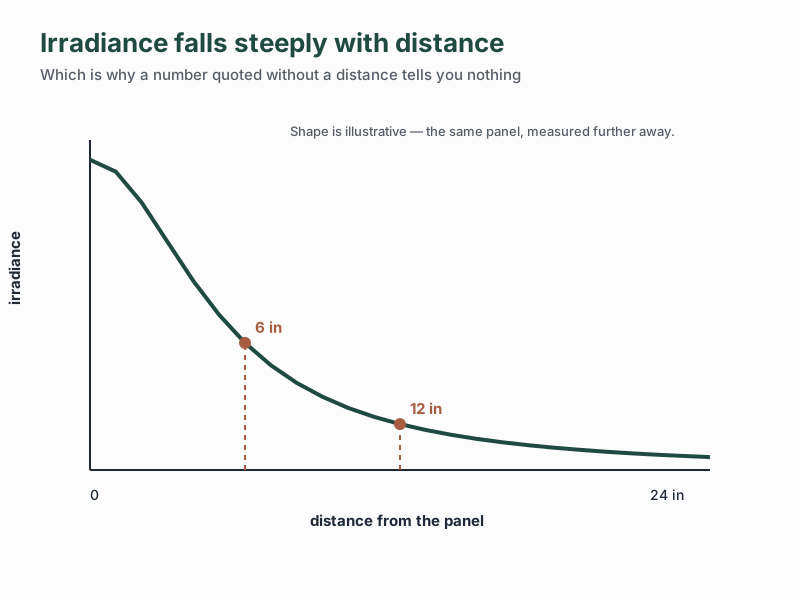
- A number without a distance is not a number. Irradiance falls steeply as you move away from the panel. "Over 100 mW/cm²" means nothing unless the distance is stated.
- The instrument matters. Consumer light meters and laboratory spectroradiometers disagree, often by a factor of two or more, because cheap meters over-read outside their calibrated range. Mito Red's own published data shows consumer solar-meter readings two to three times its lab results. A brand publishing both figures is being straight with you.
- More is not automatically better. The pillar article covers the biphasic response — beyond a point, more light stops adding benefit. Buying the highest number on the page is not a strategy.
Wavelengths: Fewer Decisions Than the Marketing Suggests
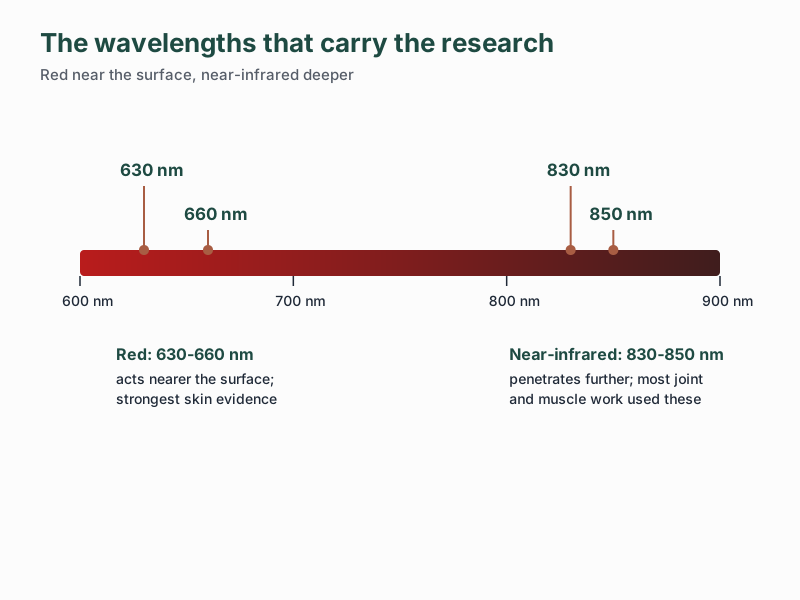
The studied wavelengths cluster in two regions: red around 630–660 nm, which acts nearer the surface and carries the strongest skin evidence, and near-infrared around 830–850 nm, which penetrates further and is where most of the joint and muscle work has been done.
Almost every serious panel combines them. Some, like Mito Red's MitoPRO+ series, split their LEDs equally across four wavelengths — 630, 660, 830 and 850 nm — rather than the usual two. Whether four beats two is not settled, and nobody should tell you it is.
Best Red Light Therapy Panels (2026)
Three panels across the range. Read each irradiance figure alongside who measured it, and at what distance.
How we chose these picks: selections are based on published specifications — the wavelengths each panel emits, whether the manufacturer publishes irradiance with a stated distance and measurement method, panel size, and power draw; where an independent measurement disagrees with the published figure, we say so and name who measured it. We do not physically test them, accept free products, or publish star ratings we cannot verify. Affiliate commission never determines what is recommended. Read our full methodology.
- 660 nm red and 850 nm near-infrared from 60 single-chip LEDs, in a 12.2" x 8.2" panel — sized for a face, a knee or a shoulder rather than the whole body
- Hooga states 73 mW/cm2 at 6 inches but names no instrument, and its own quality page calls such figures manufacturer specifications
- Three-year warranty and 60-day returns. Hooga lists 80 W of power consumption, though its manual labels the same 80 W as output power
As an Amazon Associate, we earn from qualifying purchases.
- LEDs split equally across 630, 660, 830 and 850 nm, per the product page, in 10" x 12", 12" x 24" and 12" x 36" panels drawing 90 W, 270 W and 375 W. Three-year warranty
- Mito names its lab (LightLab International) and its distance (6 inches). The 1500+ v2 averaged 56.8 mW/cm2 with a 68.2 peak, against "above 170" on a consumer solar meter
- Two inconsistencies to know: the MitoPRO+ product page labels those two figures the other way round, and Mito's lab table lists only 660 and 850 nm for this panel. Trust the lab page, and ask Mito about the wavelengths
Sold direct by Mito Red Light
- 660 nm red and 850 nm near-infrared across 150 LEDs (76 red, 74 near-infrared), 36" x 8.75" x 2.34". Joovv lists up to 88 W of light output and 250 VA of electrical consumption
- Joovv lists irradiance above 100 mW/cm2 with no distance or method stated. Light Therapy Insiders' spectrometer recorded a peak of 72.4 mW/cm2 and an average of 59.2 across nine spots — a capable panel, but short of the listed figure
- Two-year warranty on panels bought from joovv.com, and a 60-day return window. We have not put a spectrometer on any panel ourselves
Sold direct by Joovv
Which Red Light Panel Is Best for a Face or a Single Joint?
The Hooga HG300. At 12.2 by 8.2 inches it covers a face, a knee or a shoulder, it uses 660 and 850 nm, the two bands with the most research behind them, and Hooga gives its irradiance with a distance attached: 73 mW/cm² at 6 inches. It names no instrument, so treat that as the manufacturer's figure. A panel this size will not treat your back in one session; that is what the tall panels are for.
Which Red Light Panel Is Best for Full-Body Sessions?
A tall one: the 36-inch Joovv Solo 3.0, or the 12-by-36-inch MitoPRO 1500+. Treating a back or both legs at once needs something about three feet tall. Between the two, Mito documents its output better — a named lab, a stated distance, and the consumer-meter reading shown beside the lab result — where Joovv lists a single figure with neither a distance nor a method.
When the Claim and the Measurement Disagree
The Joovv Solo 3.0 is the clearest example in the category, and it is worth understanding because the pattern repeats.
Joovv lists the Solo 3.0's irradiance as above 100 mW/cm², with no distance or measuring method stated. Light Therapy Insiders tested the same panel with a spectrometer and recorded a peak of 72.4 mW/cm², an average of 59.2 across nine spots, and most readings "around the high 50s"; the review does not state its distance either. That is not a scandal, and it does not make the Solo 3.0 a bad panel. It does mean that if you were choosing between two panels on published numbers alone, you would have been comparing figures that were not produced the same way.
Mito Red's disclosure is the more useful model. Its independent test page names the lab, LightLab International, and the distance, 6 inches, and sets the lab result beside a consumer solar-meter reading. For the MitoPRO 1500+ v2, the lab measured an average of 56.8 mW/cm² and a peak of 68.2; the solar meter read above 170. One caution: the MitoPRO+ product page labels those figures the other way round, presenting the larger number as the lab result. Mito's lab page, and the product page's own note that consumer meters report higher numbers, say otherwise.
Hooga sits in between. It states a distance for the HG300 — 73 mW/cm² at 6 inches — but no instrument, and its own quality page describes such figures as manufacturer specifications, with third-party verification so far limited to a different model.
The general rule: prefer the brand that tells you how it measured over the brand with the bigger number.
Power, Size, and Warranty
Power draw is a rough proxy for how much panel you are getting, when brands report it the same way — and they do not. The MitoPRO+ range draws 90 W, 270 W and 375 W across 10×12, 12×24 and 12×36 inch panels. Joovv lists the 36-inch Solo 3.0 at up to 88 W of light output and 250 VA of electrical consumption. Hooga lists the HG300 at 80 W of power consumption, while its manual calls the same 80 W output power. None of these line up directly, which is itself a small illustration of how hard this category makes honest comparison.
On warranty, Mito Red and Hooga cover three years. Joovv covers two, and only on panels bought from joovv.com. Hooga and Joovv both offer 60-day returns. For a device that is essentially an LED array and a driver, warranty length is a reasonable proxy for how long the manufacturer expects the driver to last.
Size should follow intended use. A 10×12 panel treats a face or a knee. Treating a back or both legs at once needs something closer to three feet, and a panel too small for the job gets abandoned.
Before You Use a Red Light Panel
Red Light Panel FAQ
What irradiance do I actually need?
There is no single correct figure, because dose is irradiance times time and the useful range is bounded at both ends. What matters more is that the figure is published with a stated distance and a stated instrument, so you can compare two panels honestly.
Why do reviewers measure lower than manufacturers?
Usually instrument and distance. Consumer meters read differently from laboratory spectroradiometers, and a figure taken at the surface differs from one taken at six inches. This is why a brand publishing both numbers is more trustworthy than one publishing a bigger single number.
Is a four-wavelength panel better than two?
Unproven. The 660 and 850 nm bands carry most of the research. Additional bands are plausible but not demonstrated to add benefit, and should not be the deciding factor.
How big a panel should I buy?
Match it to the area you intend to treat. Roughly 10 by 12 inches suits a face or a single joint; full-body or full-back use needs something around three feet tall.
Do you test these panels yourselves?
No, and we say so rather than implying otherwise. We report manufacturer specifications as manufacturer specifications, and cite independent measurements by name where they exist.
Does red light therapy pair with other recovery methods?
It is commonly combined with heat and cold work. Where it fits relative to sauna and cold immersion is discussed in the research guides for each, which is the right place to make that decision rather than a product page.

Founder & Editor
Xiujun Ma is the founder and editor of Home Wellness Science, where he researches and edits evidence-based guides on sleep, nutrition, supplements, air and water quality, fitness, and the home environment. His focus is translating peer-reviewed research into practical, no-hype guidance.
Related Articles