Best Infrared Saunas (2026): Specs, and an Honest Caveat
Disclosure: This article may contain affiliate links. We may earn a small commission at no extra cost to you. This helps support our work in providing evidence-based wellness content.
Most people shopping for a home sauna end up looking at infrared, for a practical reason: an infrared cabin runs at a temperature a house can tolerate, plugs into an outlet, and does not need a drain. A traditional hot sauna is a bigger project in every direction.
Before the specs, one thing has to be said plainly, because it changes what you should buy.
Infrared or Traditional? Start Here
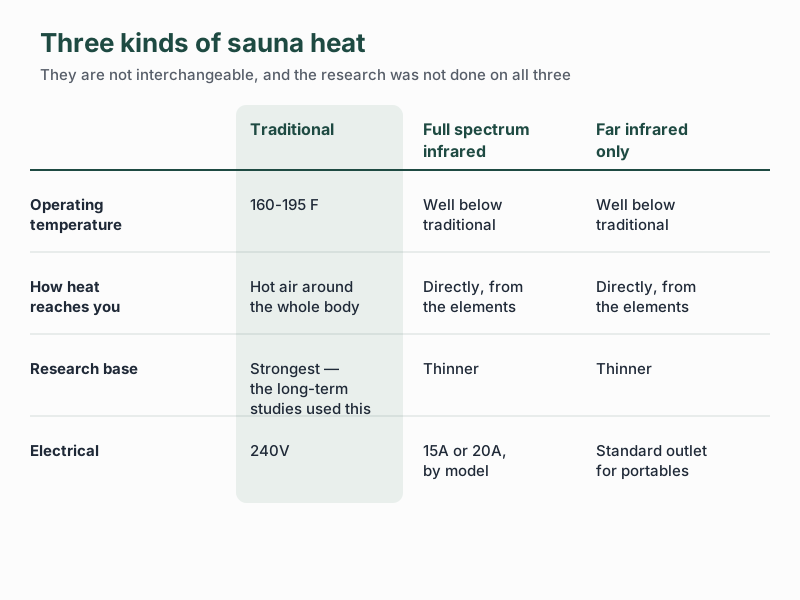
The sauna research that gets quoted — the long-running Finnish cohort work on frequency and mortality — was done on traditional saunas, not infrared. Our pillar article covers what that research does and does not establish in detail. The short version for a buying decision: the evidence base behind infrared is thinner than the evidence base behind traditional heat, and anyone selling you infrared on the strength of the Finnish data is making a substitution they have not earned.
That is not an argument against buying infrared. It is an argument for buying it with clear eyes, and for choosing traditional if your space and budget allow it.
The three categories:
- Traditional. An electric or wood heater brings the room to 160–195°F and you control humidity with water on the rocks. Needs 240V, real clearances, and usually an outdoor location. This is the type behind the research.
- Full spectrum infrared. Heaters emitting across near, mid and far infrared. Runs far cooler than traditional — the heat reaches you directly rather than through hot air.
- Far infrared only. The most common and cheapest configuration, including portable fold-up units.
The Specs That Decide It
- Heater type and placement. Wattage alone tells you little. Where the heaters sit matters more — panels behind the calves and under the floor reach parts of you that a front-wall-only cabin never will.
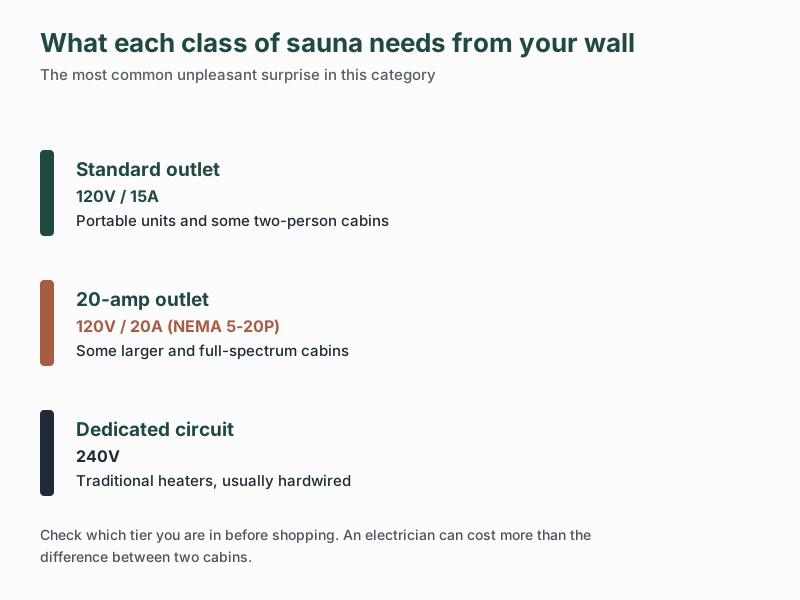
- Electrical requirement. The single most common unpleasant surprise. Portable units and some two-person cabins run on a normal 15-amp outlet; some larger and full-spectrum cabins need a 20-amp one. Traditional heaters need 240V and an electrician.
- Wood. Hemlock, cedar, basswood and mahogany all appear at this price level. Basswood and hemlock are the usual choices for people sensitive to cedar aroma.
- EMF and ELF claims. Widely advertised, rarely substantiated to a named standard. Treat an unreferenced "low EMF" badge as marketing until the brand names what was measured and by whom.
- Warranty and freight. Warranty length varies from one year to lifetime. Every cabin ships freight, and freight stops at the curb.
Best Home Saunas (2026)
Four picks spanning a portable unit to a six-person outdoor cabin. We have not assembled or operated these ourselves and do not claim to have. Every figure below comes from the manufacturer's published specification, and where a claim is the manufacturer's own rather than an independently certified measurement, it is labelled that way.
How we chose these picks: selections are based on published specifications — the type of heat (traditional or infrared, and which of the two the research was done on), the heater, the electrical supply each one needs, and the space it takes. We do not physically test them, accept free products, or publish star ratings we cannot verify. Affiliate commission never determines what is recommended. Read our full methodology.
- Dynamic rates its two-person low-EMF far-infrared cabins at 120V and 15 amps and calls them plug and play — none needs a new circuit, though some models recommend an outlet of their own
- Runs far cooler than a traditional sauna: where Dynamic states a range, it gives 118–132°F as ideal and 140°F as the maximum
- GDINA, the company behind Dynamic, does not warrant saunas bought outside its authorized channels, so check who the seller is. And remember the infrared evidence is thinner than the traditional-sauna data
As an Amazon Associate, we earn from qualifying purchases.
- Fold-up personal sauna for a fraction of a cabin price. SereneLife lists it at 120V, so it runs from an ordinary outlet — but not while folded, its manual warns
- A low-commitment way to test the habit before investing
- The gym or spa sauna remains the zero-purchase alternative
As an Amazon Associate, we earn from qualifying purchases.
- Canadian heat-treated hemlock barrel, 71" L x 72.75" W x 76.5" H and 900 lb, rated for up to six people and spacious for four
- A 6 kW Harvia KIP heater as standard, with 8 kW, Wi-Fi Harvia Spirit and 9 kW Homecraft upgrades. The heater runs on 240V and must be hardwired to your electrical panel; no light is included
- One-year limited warranty on the sauna; the heater carries one year on elements and five on other components, with Redwood handling claims. Ships freight to the curb in a 95-inch crate — the last thirty feet are your problem
Sold direct by Redwood Outdoors
- Two 500 W True Wave full-spectrum heaters on the front wall, and heaters on the back and side walls, behind the calves and under the floor
- Exterior 51.75" W x 47.75" D x 77" H at 450 lb, in mahogany or basswood. Runs at 120V / 2,260 W / 18.83 A, which needs a 20-amp outlet for its NEMA 5-20P plug — not the 15-amp socket in most rooms
- A limited lifetime warranty for residential use, labor not included. Clearlight says EMF is cancelled in its heaters and ELF through shielded wiring but names no certifying standard; the one test it links is a 2016 Vitatech report, commissioned by Clearlight, on a single 600 W heater rather than this sauna
Sold direct by Clearlight
Which Home Sauna Is Easiest to Install?
A two-person far-infrared cabin from Dynamic. Dynamic rates its two-person low-EMF models at 120V and 15 amps and calls them plug and play, so none needs a new circuit, though some models recommend an outlet of their own. Buy from an authorized seller: GDINA, the company behind Dynamic, does not warrant saunas bought anywhere else.
If even a cabin is more than you want to commit to, the SereneLife portable folds away and also runs from an ordinary outlet.
Which Home Sauna Is Closest to the Research?
The Redwood Outdoors barrel, because it is a traditional sauna: a 6 kW Harvia heater warming the air, the kind of heat the long-running Finnish studies were done on. It is also the biggest project on this page — a 240V heater hardwired to your panel, outdoor space for a barrel about six feet each way, and 900 pounds to stand somewhere solid.
Which Infrared Sauna Is Best for Full-Spectrum Heat?
The Clearlight Sanctuary 2, the only full-spectrum cabin on this page: two 500 W True Wave full-spectrum heaters on the front wall, with Clearlight's heaters also on the back and side walls, behind your calves and under the floor. No research we cover shows full spectrum outperforming far infrared alone, so buy it for the build and the heater coverage rather than for a proven advantage. Plan for its 20-amp outlet before it arrives.
Wiring, Footprint, and Freight
Three practical constraints kill more sauna purchases than price does.
Power. A Clearlight Sanctuary 2 draws 2,260 watts at 18.83 amps on 120V, which means a 20-amp outlet for its NEMA 5-20P plug, not the 15-amp socket already on your wall. A Redwood barrel's heater runs on 240V and must be hardwired to your electrical panel. A Dynamic two-person cabin or a portable fold-up unit runs from an ordinary 120V, 15-amp outlet. Establish which tier you are in before you shop, because the electrician's quote can rival the price difference between two cabins.
Footprint. Published dimensions can be interior or exterior. The Clearlight Sanctuary 2 is 46½ inches wide inside and 51¾ outside, so check which figure a listing gives before you measure the room. An outdoor barrel like the Redwood is 71 inches long by nearly 73 wide, and weighs 900 pounds — check what it is standing on.
Freight. A 900-pound sauna arrives on a truck in a crate nearly eight feet long — Redwood's is 95 inches — and curbside is where the driver's obligation ends. Arrange the last thirty feet in advance.
What About the Warranty?
Warranty is where the price difference becomes legible. Redwood covers the sauna for one year, and the Harvia heater for one year on its elements and five on its other components, with Redwood handling claims. Clearlight states a lifetime warranty; its warranty page makes that a limited lifetime warranty for residential use, with labor not included. On a purchase in this bracket that difference is worth real money, and it is a fair part of why the cabins cost what they do.
Read what is actually covered rather than the headline word. "Lifetime" on a structure and "lifetime" on electronics are different promises, and manufacturers are not always quick to distinguish them.
Before You Use a Sauna
Home Sauna FAQ
Is an infrared sauna as good as a traditional one?
The research base is not equivalent. The frequently cited long-term sauna studies were conducted on traditional saunas. Infrared has its own smaller literature. If you want the type the evidence was built on, that is traditional — see our guide to the research for what it does and does not show.
Does an infrared sauna need special wiring?
Sometimes. Portable units and some two-person cabins, such as Dynamic's, run on an ordinary 120V, 15-amp outlet. Some larger and full-spectrum cabins need a 20-amp outlet — the Clearlight Sanctuary 2 does — and traditional heaters need 240V, hardwired. Confirm the requirement against your actual panel before ordering.
How much space does a home sauna need?
A one or two person cabin occupies roughly four feet by four, plus clearance for servicing. A six-person outdoor barrel is around six feet by six and weighs about 900 pounds.
Are low-EMF sauna claims meaningful?
Sometimes. The claim is meaningful when the brand names the measurement and who performed it, and close to meaningless when it is a badge with no reference. Check what was actually tested, too: the one report Clearlight links is a 2016 test of a single heater, not of the cabin you would buy. Ask for the figure.
What is the cheapest way to try a sauna habit?
The sauna at a gym or pool, which costs nothing extra and uses the traditional heat the research is based on. A portable fold-up unit is the cheapest thing you can own. Neither commits you to a cabin, and the habit is the part worth testing first. A sauna blanket is a further step down in both price and capability.
How long do home saunas last?
The cabin generally outlives the electronics. That is why warranty terms that separate structure from heating elements and controls are worth reading closely before you buy.

Founder & Editor
Xiujun Ma is the founder and editor of Home Wellness Science, where he researches and edits evidence-based guides on sleep, nutrition, supplements, air and water quality, fitness, and the home environment. His focus is translating peer-reviewed research into practical, no-hype guidance.
Related Articles