Best Cold Plunge Tubs (2026): What You Actually Need
Disclosure: This article may contain affiliate links. We may earn a small commission at no extra cost to you. This helps support our work in providing evidence-based wellness content.
A cold plunge tub is a container of cold water. Everything above that — chillers, ozone, filtration, insulation — exists to solve one problem: keeping the water cold and clean without you hauling ice every morning. How much you should spend depends entirely on how badly you need that problem solved.
This page is about the equipment. If you are still deciding whether cold immersion is worth doing at all, the evidence is covered separately in our guide to what cold water immersion actually does, including where the research is strong and where it is thin. What follows assumes you have already decided.
What to Look For in a Cold Plunge Tub
Five specs decide whether a tub is still in use a year from now.
- Minimum temperature, and whether it holds. A chiller's lowest rated temperature is close to meaningless on its own. The number that matters is the ambient temperature it can maintain that minimum in. A unit that reaches 37°F in a 65°F basement may not hold it in a 100°F garage in August.
- Water volume. More water is more stable and more comfortable, and also more to cool, filter and eventually drain. Residential tubs generally run somewhere between 80 and 200 gallons.
- Filtration and sanitation. This decides whether you change the water weekly or monthly. It is the single largest difference in day-to-day hassle between a barrel and a self-contained unit.
- Power. Whether it runs on an ordinary 120V outlet or needs a dedicated circuit, and whether a GFCI is built in or is your electrician's problem.
- Footprint and delivery. Both the tub's dimensions and the crate's. These arrive by freight, and freight means curbside.
Chiller or Ice? The Decision That Sets Your Budget
This is the fork, and it is worth more thought than which brand you pick.
Ice only. A tub and bags of ice. Cheapest to buy, and the ongoing cost is real — daily ice for one person adds up to a meaningful monthly bill, and it is a chore attached to every single session. The failure mode is not expense, it is that you stop.
Tub plus separate chiller. A portable or barrel tub with a standalone chiller plumbed in. More flexible, more components, more places for a leak. Reasonable if you already own the tub.
Self-contained. Chiller, filtration and sanitation built into one unit. Costs the most by a wide margin and removes essentially all of the maintenance friction.
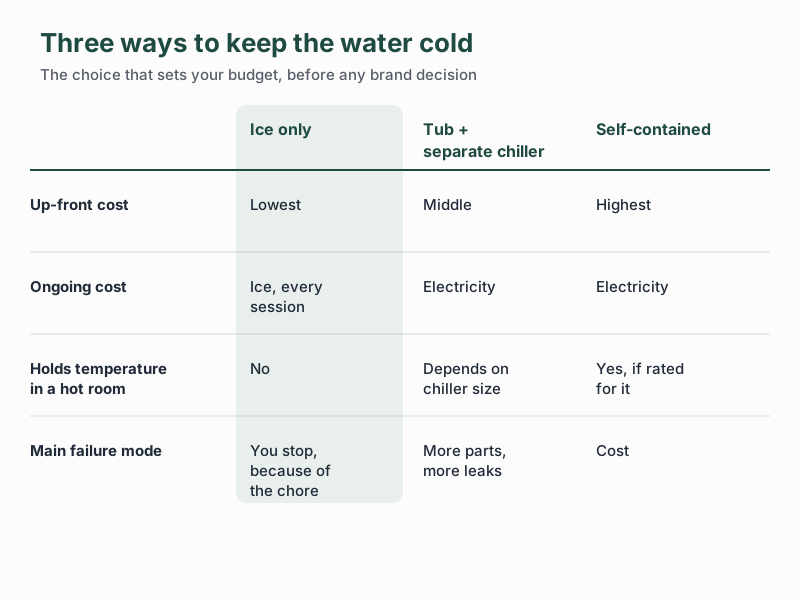
The honest summary: if you are not sure you will keep the habit, do not buy the chiller yet. The habit is the hard part, and a foldable tub tests it as well as a self-contained unit that costs many times more. Our pillar article makes the same point about the exposure mattering more than the equipment.
Best Cold Plunge Tubs (2026)
Three picks across the range. We have not tested these in our own lab, and we do not claim to have — every specification below is taken from the manufacturer's published documentation, and where a figure is the manufacturer's own claim we say so.
How we chose these picks: selections are based on published specifications — chiller capacity and the temperature it can hold, insulation, filtration, and the space and power each setup needs. We do not physically test them, accept free products, or publish star ratings we cannot verify. Affiliate commission never determines what is recommended. Read our full methodology.
- A foldable, insulated tub with a lid — it packs away between sessions and needs no plumbing or power
- Check the filled weight before you pick a spot: water weighs about 8.3 lb a gallon, so a 100-gallon tub puts over 800 lb on the floor
- Ice does the cooling, so it costs nothing to run beyond the ice — the cheapest way to find out whether the habit sticks before paying for a chiller
As an Amazon Associate, we earn from qualifying purchases.
- Cools to 37F and holds it — Plunge's product page rates the 0.75 HP chiller (1 HP on its comparison page) to maintain 37F in 120F ambient air, which is the specification that matters in a garage in August
- 105-gallon tub, 76.75" L x 31.5" W x 28.75" H, with a GFCI built into its seven-foot cord. It needs a dedicated 120V circuit: 15 amps on the product page, 20 amps in Plunge's support article and manual — plan for 20
- Ozone sanitation and double filtration stretch the time between water changes: Plunge says at least every six months with its recommended water-care chemicals, every one to three months without. One-year warranty
Sold direct by Plunge
- 1 HP compressor reaching 36F, rated for ambient air up to 95F; Plunge Chill states it takes 110 gallons from 80F down to 40F in about eight hours
- Connects to most tubs through inlet and outlet hoses, with a 20-micron inline filter; tubs without ports use the submersible pump it comes with. 16.5" x 13.8" x 18.9", 73 lb, on caster wheels
- The product page advertises a two-year "usability guarantee" whose own wording covers repairs in the first year, and the FAQ says one-year warranty — read it as one year. A fraction of the cost of a self-contained unit if you already own the tub
Sold direct by Plunge Chill
Which Cold Plunge Is Best If You Are Not Sure You Will Keep It Up?
The foldable tub with a lid. It needs no power and no plumbing, ice does the cooling, and it folds away if the habit does not stick. That makes it the cheapest honest test of whether cold immersion fits your week, and the habit, not the hardware, is the thing you are testing.
Before you fill one, decide where it will stand. Water weighs about 8.3 pounds a gallon, so a 100-gallon tub puts over 800 pounds on the floor — a real load for a balcony or an upper floor.
Which Cold Plunge Is Best for a Hot Garage?
The Plunge All-In. Plunge states its chiller can maintain 37°F in 120°F ambient air, while Plunge Chill lists its 1 HP unit for ambient temperatures up to 95°F, so only the All-In is rated for the hottest garages. That ambient figure is the one to compare between units, since a chiller that reaches 37°F in a cool basement may not hold it through a summer afternoon.
Which Chiller Is Best If You Already Own a Tub?
A standalone unit such as the Plunge Chill 1 HP. It connects to most tubs through inlet and outlet hoses, and tubs without ports use the submersible pump it comes with. Plunge Chill states it takes 110 gallons from 80°F to 40°F in about eight hours. It costs a fraction of a self-contained unit; the trade-off is a second box to house, plumb and keep clean.
Filtration, Sanitation, and the Maintenance Nobody Mentions
Cold water does slow microbial growth. It does not stop it, and a tub you sit in after exercise accumulates skin cells, sweat and hair like any other body of water.
Barrels and portable tubs without filtration need draining and refilling on a regular schedule. That is both a water bill and a job. Units with filtration circulate the water through a filter continuously; units that add ozone sanitation go further, oxidising contaminants between sessions. The Plunge All-In pairs ozone with double filtration, which stretches the time between changes: Plunge says to change the water at least every six months with its recommended water-care chemicals, or every one to three months without them.
Whatever you buy, budget for replacement filters and check how often the manufacturer wants them changed before you commit.
Space, Power, and Delivery
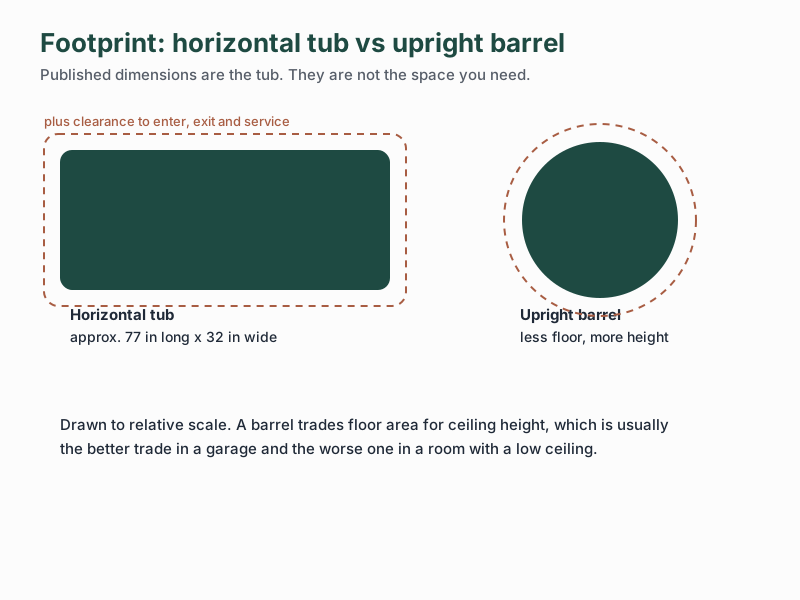
The dimensions on a product page are the tub. They are not the space you need.
A horizontal tub such as the Plunge All-In measures 76¾ inches long by 31½ wide by 28¾ high — call it six and a half feet by two and a half. You also need room to get in and out, and access to the chiller end for service. An upright barrel trades floor area for height, which is usually the better deal in a garage and the worse one in a room with a low ceiling.
On power, check what circuit the unit needs before it arrives. The Plunge All-In runs on 120V through a seven-foot cord with a GFCI built in, but it needs a circuit to itself, and Plunge gives two figures for it: a dedicated 15-amp circuit on the product page, 20 amps in its support article and manual. Plan for the 20-amp circuit. If nothing in the space is on a circuit of its own, that means an electrician.
On delivery, these ship freight. Freight means the truck stops at the curb, and the driver is not obliged to help you move a crate weighing well over 200 pounds up a driveway. Plan that before it arrives rather than on the day.
Before You Plunge
Cold Plunge Tub FAQ
How cold does a cold plunge tub need to get?
Most chillers in this category are rated to somewhere around 37°F, which is colder than most people will ever actually use. The more useful question is whether the unit holds your chosen temperature in the room you will keep it in, during the hottest month of your year.
Do I need a chiller, or is ice enough?
Ice works. It costs money every session and it is a daily chore, which is what tends to end the habit rather than the cost. A chiller buys convenience, not results.
How much space does a cold plunge tub take up?
A horizontal tub is roughly six and a half feet by two and a half feet on the floor, plus clearance to enter and exit and access for servicing. Upright barrels use less floor and more height.
Can a cold plunge tub run on a normal outlet?
An ice-only tub needs no power at all. A chilled one usually runs on ordinary 120V but wants a circuit of its own: the Plunge All-In needs a dedicated circuit, rated at 15 amps on its product page and 20 amps in Plunge's support article and manual. Confirm the circuit before buying rather than after delivery.
How often do I change the water?
It depends on filtration and on what you add to the water. An unfiltered barrel needs draining on a regular schedule; a unit with filtration and ozone sanitation lasts considerably longer. For the Plunge All-In, Plunge says at least every six months with its recommended water-care chemicals, or every one to three months without them. Check the manufacturer's stated interval and filter replacement schedule.
Is a cold plunge tub worth the money?
That depends on whether you will use it, which is a question about you rather than the equipment. Start cheap, prove the habit, then buy the convenience if the habit sticks. Pairing cold work with heat exposure or building it into a wider recovery routine is a decision worth making before you buy top-end equipment for either.

Founder & Editor
Xiujun Ma is the founder and editor of Home Wellness Science, where he researches and edits evidence-based guides on sleep, nutrition, supplements, air and water quality, fitness, and the home environment. His focus is translating peer-reviewed research into practical, no-hype guidance.
Related Articles