VO2 Max by Age: What Counts as Good, and Why It Matters
VO2 max is the single number most worth knowing about your cardiovascular fitness, and most people first meet it as a figure their watch quietly assigned them. This covers what a good VO2 max looks like by age and sex, what the mortality evidence actually shows, and how far off that watch estimate probably is.
The short version: the association with lifespan is one of the strongest in the epidemiology of exercise, the reference values are lower than most people assume, and your wrist-based number could be out by twenty points in either direction.
What Is VO2 Max, and How Is It Measured?
VO2 max is the maximum rate at which your body can take in oxygen, deliver it to working muscle, and use it to produce energy. It is expressed in millilitres of oxygen per kilogram of body weight per minute — mL/kg/min — so it scales to your size.
Measuring it properly means a graded exercise test to exhaustion while breathing through a mask that analyses expired gas. You run or cycle at progressively harder stages until oxygen uptake stops rising despite increasing workload. That plateau is your maximum.
One detail that explains a lot of confusion: the test mode changes the number. In the FRIEND registry, the reference database assembled from US clinical exercise laboratories, the median value for men aged 20 to 29 was 48.0 mL/kg/min on a treadmill but 41.9 on a cycle ergometer. For women in the same bracket it was 37.6 on a treadmill and 31.0 on a cycle. If your gym test and your clinic test disagree, the machine may be the reason before your fitness is.
What Counts as a Good VO2 Max?
Here is where most pages on this topic publish a confident-looking grid of every age decade. We are going to be more careful, because those grids are copied between sites and rarely sourced.
The FRIEND registry reports these median (50th percentile) treadmill values:
- Men, 20–29: 48.0 mL/kg/min, declining to 24.4 by ages 70–79
- Women, 20–29: 37.6 mL/kg/min, declining to 18.3 by ages 70–79
FRIEND's later global dataset, drawing on laboratories outside the US as well, put the 20–29 medians slightly higher — 49.5 for men and 40.6 for women — and reported that VO2 max declined by an average of 9% per decade, reaching 30.8 and 25.0 respectively by ages 70 to 79.
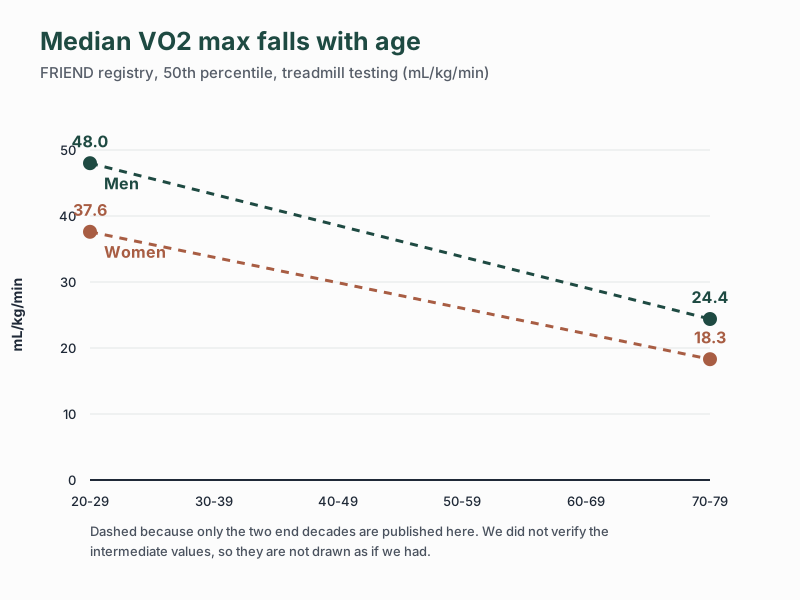
Those are the anchors we can state with a source attached. We are deliberately not publishing an invented value for every intervening decade, because we have not verified them line by line and this is a health site. For your exact age bracket, the full percentile tables are in ACSM's Guidelines for Exercise Testing and Prescription, which reproduces the Cooper Institute and FRIEND reference standards.
Two things are worth taking from the anchors even without the full grid. A median is not a goal — half the tested population sits below it. And the gap between the sexes is real and physiological, driven largely by differences in haemoglobin concentration and heart size, which is why comparing your number to a friend's without matching for sex and age tells you almost nothing.
Why VO2 Max Predicts Lifespan Better Than Almost Anything Else
The strongest single piece of evidence comes from a 2018 cohort study in JAMA Network Open. Researchers at the Cleveland Clinic followed 122,007 patients who had undergone exercise treadmill testing between 1991 and 2014, accumulating 1.1 million person-years of observation, over which 13,637 patients died.
Comparing the fittest group to the least fit, the adjusted hazard ratio for all-cause mortality was 0.20 (95% CI, 0.16–0.24). Read the other way round, being in the lowest-fitness group carried an adjusted hazard ratio of 5.04 (95% CI, 4.10–6.20) relative to elite fitness.
The comparison that makes that figure land is what the same model produced for conventional risk factors in the same population:
Low cardiorespiratory fitness: HR 5.04 · Smoking: HR 1.41 · Diabetes: HR 1.40 · Coronary artery disease: HR 1.29
In this cohort, poor fitness was associated with a larger mortality hazard than smoking, diabetes or established coronary disease. The authors also found no upper limit to the benefit — the fittest performers had the lowest risk, with no plateau where more fitness stopped helping.
Two honest caveats. This is an observational cohort of people referred for treadmill testing, not a randomised trial, so it establishes association rather than proof of cause. And reverse causation is a genuine concern: undiagnosed illness lowers fitness as well as raising mortality. The effect size is large enough, and consistent enough across cohorts, that most researchers treat it as real — but "associated with" is doing necessary work in that sentence.
How to Check Your VO2 Max
Three routes, in descending order of accuracy.
A laboratory CPET. The graded test with the mask described above, run by an exercise physiologist or a cardiology department. This is the measurement everything else is estimating. It typically costs money and takes about an hour including familiarisation.
A submaximal field test. The Cooper 12-minute run, the Rockport walk test and various step tests estimate VO2 max from how far you cover or how fast your heart rate recovers. Free, repeatable, and reasonable for tracking change in yourself over time even when the absolute number is imprecise.
Your watch. Apple Watch and Garmin both report a VO2 max estimate derived from the relationship between your pace and your heart rate during outdoor activity. No gas is analysed; the number is inferred. Which brings us to the part most pages skip.
How Accurate Is Your Watch, Really?
A 2025 validation study published in PLOS One compared Apple Watch estimates against indirect calorimetry, the laboratory reference. The watch underestimated VO2 max by a mean difference of 6.07 mL/kg/min, with a mean absolute percentage error of 13.31%.
The number that matters more is the limits of agreement, which describe the range within which most individual differences fell: −6.11 to +18.26 mL/kg/min.
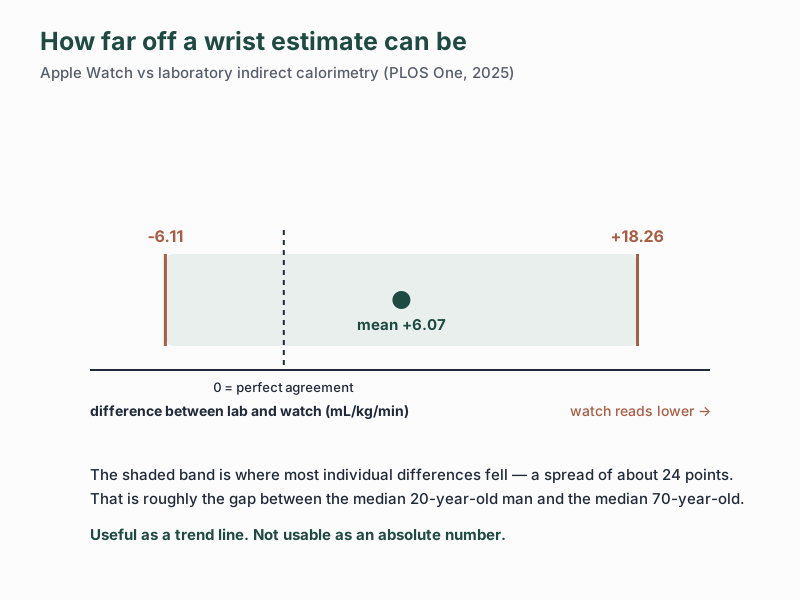
That is a spread of roughly 24 points. For context, 24 points is most of the distance between the median 20-year-old man and the median 70-year-old man. An earlier validation of the Series 7 reported a mean absolute percentage error of 15.79%, in the same territory.
Garmin's estimate, built on Firstbeat's analytics, is generally reported as closer for moderately trained people running outdoors, and less reliable on the bike than on foot — though we have not found a validation of it as rigorous as the Apple Watch work above, so treat that as the weaker claim it is.
The practical reading: your watch is a trend line, not a measurement. If it moves up four points over six months of consistent training, that is meaningful information about you. If it says 42 and your friend's says 46, that comparison is inside the noise.
How to Actually Improve It
VO2 max responds to training more reliably than almost any other longevity-associated marker, which is the genuinely encouraging part of all this. Two ingredients do most of the work.
A large base of easy aerobic work. Most of your weekly volume should be at an intensity where you could hold a conversation. This is the part people skip because it feels too easy to be useful, and it is the part that builds the cardiac output and capillary density the number depends on. If you are starting from nothing, brisk walking genuinely counts — the research on step count and health outcomes is stronger than its unglamorous reputation suggests.
A small amount of genuinely hard work. Intervals near maximum effort are what push the ceiling up. The classic protocol is four blocks of about four minutes hard, with roughly three minutes easy between them, once or twice a week. It is unpleasant by design and does not need to be frequent.
Beyond that, the honest advice is unremarkable: keep it consistent, keep it sustainable, and do not add intensity faster than you add recovery — adaptation happens while you sleep, not while you train, which is why sleep architecture belongs in any serious training conversation. Our guide to the minimum effective dose of exercise covers how little is genuinely required to move health markers, and what the evidence says about rest days is worth reading before you stack three interval sessions into a week.
Strength work is not a substitute — it does not raise VO2 max much on its own — but it belongs in the week regardless, and you do not need a gym for it.
One adjacent finding worth knowing: regular sauna use has been associated with improved cardiorespiratory fitness in Finnish cohort research, which is covered in our guide to what twenty years of sauna research shows. It is an association rather than a replacement for training, and the article is careful about the difference.
VO2 Max FAQ
What is a good VO2 max for a woman?
Relative to her own age bracket rather than to men. The FRIEND registry median for women aged 20 to 29 was 37.6 mL/kg/min on a treadmill, falling to 18.3 by ages 70 to 79. A median means half the tested population scored lower, so matching it is average rather than good.
What is a good VO2 max for a man?
The same registry reported a median of 48.0 mL/kg/min for men aged 20 to 29 on a treadmill, declining to 24.4 by ages 70 to 79. Being comfortably above the median for your decade is the meaningful target.
Why is my VO2 max lower on a bike than on a treadmill?
Because cycling uses less total muscle mass than running. In FRIEND, median cycle values ran roughly six to seven points below treadmill values in the same age bracket. It is the test, not a decline in your fitness.
How accurate is the Apple Watch VO2 max?
A 2025 PLOS One validation found it underestimated by a mean of 6.07 mL/kg/min with limits of agreement from −6.11 to +18.26. Useful for tracking your own trend, unreliable as an absolute figure or for comparing against someone else.
How quickly can VO2 max improve?
Measurable change generally takes weeks to months of consistent training rather than days, and beginners improve faster and further than already-trained people. The rate depends heavily on your starting point.
Does VO2 max decline with age no matter what?
Average values decline across every published dataset — roughly 9% per decade in FRIEND's global figures. Training does not stop the decline, but it shifts which curve you are on, and an active 60-year-old can hold a higher value than a sedentary 40-year-old.

Founder & Editor
Xiujun Ma is the founder and editor of Home Wellness Science, where he researches and edits evidence-based guides on sleep, nutrition, supplements, air and water quality, fitness, and the home environment. His focus is translating peer-reviewed research into practical, no-hype guidance.
Related Articles


Resistance Bands vs Free Weights: What Science Says About Home Strength Training
Elastic resistance is not a toy and dumbbells are not automatically superior. This guide explains what the research says about bands, free weights, hypertrophy, max strength, and the smartest home setup for real-world training.
